RESEARCH AND DEVELOPMENT
Research projects supporting sustainable exploration
At GeoPool, we are committed to advancing responsible and innovative mineral exploration across Europe. Our company plays an active role in both national and EU-funded research projects that support the sustainable discovery of raw materials essential for Europe’s green transition and economic resilience.
Strategic collaborations with geological surveys, universities, and industrial partners enable us to stay at the forefront of exploration research and novel technologies while contributing to the development of industry best practices and tools.
CONTRIBUTING TO EXPLORATION OF RAW MATERIALS
SEMACRET 2022 – 2025
SEMACRET (Sustainable Exploration for Orthomagmatic Critical Raw Materials in the EU) is a Horizon Europe-funded project advancing the sustainable exploration of critical raw materials (CRMs) essential for Europe’s green energy transition. These include nickel, copper, cobalt, vanadium, titanium, chromium, and platinum-group elements.
The project focuses on orthomagmatic mineral systems and applies a mineral systems approach. This method that considers the entire geological environment to predict the location of valuable deposits more accurately.
Research is carried out in Finland, Portugal, Poland, and Czechia, chosen for their diverse geological settings and social contexts.
SEMACRET places strong emphasis on environmental and social responsibility, aiming to make mining more sustainable and publicly accepted. It also integrates social sciences to foster community engagement and improve understanding of responsible resource development.
The project brings together 17 partners across Europe, coordinated by the University of Oulu. GeoPool contributed to the data collection and resource estimation tasks.
GREENPEG 2020 – 2024
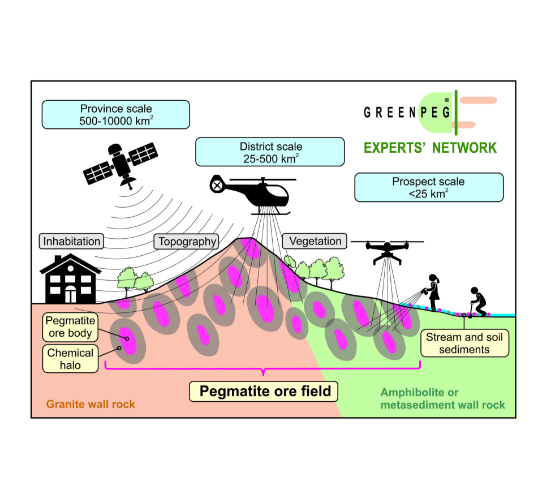
The GREENPEG Experts’ Network for pegmatite exploration was a Horizon 2020-funded project aimed at increasing European raw material resources, enhancing databases on raw materials, and improving the competitiveness of EU companies.
The project developed and validated a new multi-method, low environmental impact toolset to explore buried pegmatite-hosted deposits of rare metals (Li, Ta, Sn, Be, Rb, and Cs), high-purity quartz, and ceramic feldspar, supporting the green energy transition.
The network continues to maximise pegmatite exploration success by providing small and medium size companies:
- Access to GREENPEG Toolset description and guidance
- Initial advice on choice of GREENPEG tools
- Exploration planning services and guidance on Toolset implementation
- Desktop and field exploration services
GeoPool participated in the GREENPEG think tank and continues to be part of the Experts’ Network.
DEVELOPING NOVEL EXPLORATION METHODS
AIMEX subproject 2023–2026 (Ongoing)
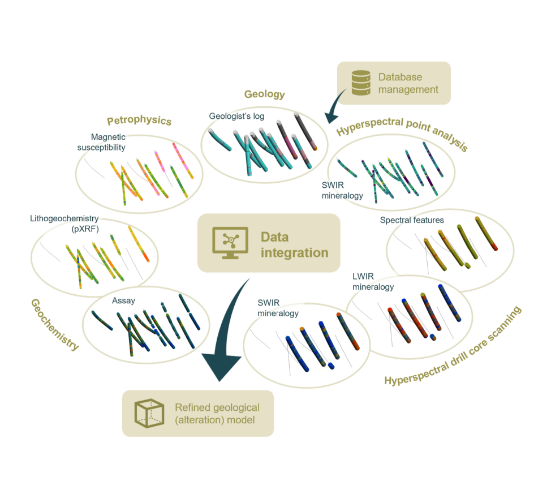
The AIMEX subproject is a machine learning framework for target-scale 3D mapping of geological features with special emphasis on hyperspectral data.
AIMEX (Artificial Intelligence in Mineral Exploration) is a Business Finland-funded co-innovation project that brings together research teams from the Geological Survey of Finland, the University of Turku, and the Finnish Environment Institute, along with several industry partners who are contributing through their own development projects. The goal is to utilise artificial intelligence to improve mineral exploration techniques and concepts to find new targets in both under-explored areas and well-studied regions with lots of existing data.
As part of the AIMEX project, GeoPool aims to develop data-driven methodologies to optimise the use of large, complex, and generally multi-dimensional geological datasets. This involves the development of workflows for efficient handling (database management), processing, and fusion of datasets to sophisticated geological models. The 3D modelling approach has applications in better defining drilling targets and improving the understanding the target geology and deposit models, aiding decision-making.
SEEMS DEEP 2022 – 2025
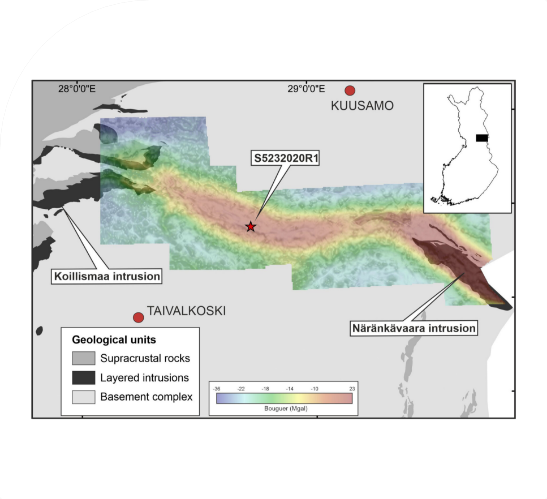
SEEMS DEEP (Seismic and Electromagnetic Methods for Deep Mineral Exploration) was a EU Horizon 2020-funded geophysical research project with the ambition to develop novel, integrated workflow to detect deep-seated mineral deposits. The team combined seismic (e.g. underground sound waves) and electromagnetic methods to create detailed 3D maps of what’s beneath the surface.
The test site was the Koillismaa Layered Igneous Complex in Finland, a promising area for battery-critical raw materials listed by the EU. The project leveraged data from a 1.7 km deep drill hole to refine its models and establish empirical links between conductivity and seismic velocity.
By enhancing its deep exploration capabilities, SEEMS DEEP contributes to Europe’s goal of achieving raw materials self-sufficiency with lower environmental impact.
In the project, GeoPool represented Laakso Minerals Oy.
HypeLAP 2020 – 2022
The Hyperspectral Lapland (HypeLAP) project studied practical solutions for mineral exploration by taking advantage of the state-of-the-art hyperspectral measurement instrumentation. The project was financed by the European Regional Development Fund in the Sustainable Growth and Jobs 2014–2020 programme and implemented by the Geological Survey of Finland (GTK). Industry partners supported the project by participating in steering group work.
In addition to the geological research, the project promoted the hyperspectral imaging-based digitalisation of the GTK’s National Drill Core Archive. The project also explored the possibilities of establishing a new service centred on hyperspectral imaging, initially targeting mining and mineral exploration companies operating in Lapland. The project results contribute to increasing knowledge of the hyperspectral method in mineral exploration.
GeoPool participated in the project steering group and was responsible for the hyperspectral core imaging together with TerraCore.
UpDeep 2017 – 2020
Upscaling deep-buried geochemical exploration techniques into European business (UpDeep) was a three-year project funded by the EIT (European Institute of Innovation and Technology) Raw Materials. The project aimed to develop the geochemical expertise on deep-buried exploration and anchor this knowledge as a local surface geochemical business in Europe.
Within UpDeep, solutions were found for several technical aspects of surface geochemistry, including efficient sampling protocols, sample media selection, the production of a surface geochemical standard reference material bank, and compositional data analysis. A web-based data analysis and delivery platform, combined with an open-access database, was also created to facilitate efficient data interpretation and comparison. Additionally, workshops were conducted to educate clients on the suitability of surface geochemical sampling media in different environments.
GeoPool was highly involved in the UpDeep project with tasks in data collection, data management, and marketing.
GeoPool is also responsible for the distribution of the created standard reference materials suitable for surface geochemical exploration surveys related to Au-REE deposits. These include standard soil reference materials collected from Ah and B horizons, and standard biochemical reference materials representing common juniper foliage and Norway spruce bark and foliage.
Indika 2016 – 2019
The Indika project, supported by the European Regional Development Fund, aimed to develop new methods and study their applicability to the exploration of critical metals and minerals, both in the context of the latest ore deposits and existing mining environments.
The main outcome of the project was a new, field-tested, and documented procedure for the pre-treatment and analysis of indicator mineral samples. Other developments in the project included a procedure for the concentration of indicator mineral samples, the use of portable analysers (in particular, portable XRD analysers) and automated laboratory methods for identifying critical minerals, as well as mobile data transfer from portable XRF analysers. In addition, the functioning of the network of northern training and research institutes was improved as a methodological developer in the mining sector.
UltraLIM 2013 – 2015
The Ultra Low-Impact Exploration Methods in the Subarctic (UltraLIM) project, funded by the Tekes Green Mining Programme, compared several ultra-light geochemical methods and sampling techniques to find the best practices for geochemical mineral exploration within the glaciated subarctic regions. The studied sample media comprised sediments of the upper parts of soils, organic layers, plants, and snow.
The research was conducted on known mineral deposit targets provided by the Geological Survey of Finland (GTK) and the project’s industry partners. Research partners of the project were GTK and the University of Oulu. GeoPool took part in the steering group of the project.
PUBLICATIONS
Advancing knowledge in exploration
Explore a selection of our research contributions in exploration techniques, ore deposits, minerals, and other geosciences.
CONSTANTLY IMPROVING
At GeoPool, we strive for a high-quality level in all our services. Thus, we regularly review and improve our services and internal processes to stay up to date with the recent industry developments.
GeoMax was our latest internal development project, designed to support strong domestic and international growth. The project focused on developing new services, enhancing digitalization, and streamlining internal processes. With a total budget of 320,905€, GeoMax was co‑funded by the European Regional Development Fund, which contributed 153,401€. The project ran from 1 June 2024 to 31 March 2026.